Pocket-Sized and Painted Bold: Choosing Colour for the Downstairs Loo
Every UK home has one: a room roughly the size of a generous wardrobe, tucked under the stairs or borrowed from the back of the hall. It has no window, a basin the size of a cereal bowl, and a door that guests will open within four minutes of arriving. Nobody lingers in there, but everybody sees it. Which makes it, somewhat unfairly, one of the highest-stakes decorating jobs in the house.
The good news is that it's also the cheapest room to repaint and the quickest to turn around. A single tin will comfortably do the walls, and you can experiment in a way you'd never dare in a living room. So let's talk about doing it properly.
Start with the bulb, not the colour card
Most downstairs loos have no natural light at all, and the ones that do usually have a small obscured window above head height that contributes roughly the brightness of a phone screen. That means the colour you choose will be lit almost entirely by whatever is screwed into the ceiling.
This matters more than most people expect. A warm 2700K bulb will pull a soft grey-green towards olive and make a taupe look almost brown. A cooler 4000K bulb will turn the same shade chalky and slightly blue. Neither is wrong — but you want to know which one you're getting before the paint goes on.
So do this: paint two or three generous patches (a sheet of A4 or bigger, not a smear) onto the wall, leave them for a couple of days, and look at them in the evening with the light on and the door shut. That's the only viewing condition that counts. If you find the current bulb flatters nothing, changing it is a ten-pound fix that will do more for the room than a fancier paint.
Why small rooms handle dark colour better than you'd think
There's a persistent belief that a tiny room must be painted in something pale, ideally a nice inoffensive off-white, or it'll feel like a cupboard. In practice, the opposite is often true.
A very pale wall in a dim, cramped space tends to read as grey and dim — you're lighting a room with reflected light that has nowhere to bounce. A deep, saturated colour, on the other hand, stops pretending. If you wrap it around every surface — walls, ceiling, skirting, door, maybe even the radiator — the edges of the room dissolve and the whole thing reads as a deliberate, jewel-like box rather than a corridor with a toilet in it.
Deep teal, forest green, oxblood, inky blue, a proper aubergine: all of these earn their keep in a downstairs cloakroom, especially if the fittings are simple and the floor is plain. The trick is committing. A dark feature wall in a two-square-metre room just looks like you ran out.
And when the calmer route is the right one
Bold isn't the automatic answer, though. If your loo doubles as a boot room, a buggy park or the only route to the garden, you'll want something that doesn't shout every time the door opens. Same if the floor tiles are already busy, or if the ceiling dips below about 2.1 metres and you don't want to feel personally involved with it.
In those cases, a mid-tone — a warm clay, a soft sage, a muddy putty — does the job without theatrics. It's forgiving of scuffs, doesn't fight a patterned floor, and reflects enough light to keep the space from feeling like a cave. Pair it with white trim for a crisp edge, or match the trim to the walls for a quieter, more modern look.
Don't forget the fifth wall
The ceiling gets ignored in small rooms and it shouldn't. If you're going bold, take the ceiling with you — it's the single change that makes the scheme look designed rather than accidental. If you're going calmer, keep the ceiling a shade or two lighter than the walls, in the same family, so it lifts without glaring.
Then there's the door. Painting the inside of the loo door the same colour as the walls is a small, cheap move that finishes the room off. The skirting and architrave deserve the same decision: same as the walls for a drenched look, or a clean white or off-black for definition. Nothing looks more unfinished than walls freshly done above skirting that's been there since 1998.
Moisture, splashes and paint that survives
Here's the unglamorous part. A downstairs loo is a small, poorly ventilated, occasionally damp box. Standard matt emulsion will look lovely for about eight months and then develop a slightly chalky, patchy quality, particularly behind the basin and around the door handle.
Go for a moisture-tolerant finish — most brands sell a kitchen and bathroom formula — and use it on the walls at the very least. An eggshell or low-sheen finish on the lower half of the walls, and around the basin, makes wiping down far less stressful. Ceilings can take a matt that's formulated for damp rooms; a shiny ceiling in a small space is a mistake you'll notice every single time you look up.
Check the extractor fan actually works before you decorate, not after. And if you've had condensation or mould issues in there, deal with the cause first — paint over a damp problem and it will simply come back through. Give the room a good few days of proper drying between final coat and heavy steamy use, too. It's the least glamorous advice in this article and the most likely to save you a repaint.
Mirrors, light and the last ten percent
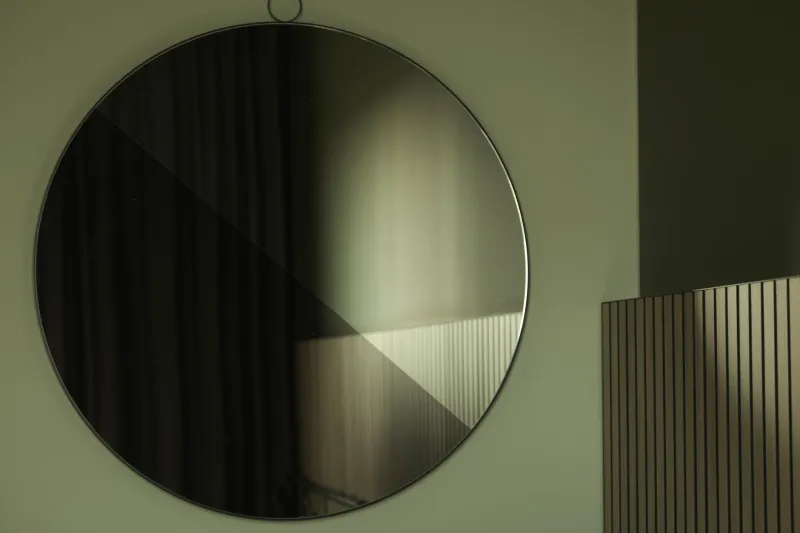
A decent mirror is the closest thing to a window you'll get in there. Put it where it reflects something worth looking at — a bit of the hallway, a wall light, a shelf — rather than straight back at the opposite wall. A slim full-height mirror on a narrow wall will make the room feel taller for very little money.
Beyond that: one good ceiling light or a pair of wall lights either side of the mirror, a shelf that's actually level, and a hook on the back of the door. Small rooms are won or lost on these details, and none of them cost much.
The bottom line
The downstairs loo is a two-tin job with a guest-facing job description. Treat the colour as a decision rather than an afterthought, test it under the bulb that will actually light it, and commit — whether that's a deep, drenched green or a soft, forgiving clay. Either way, it'll be the room people mention on the way out, and that's rather the point.