Sun Trap or Sweatbox: Getting Conservatory Colour Right in a Glass-Heavy Room
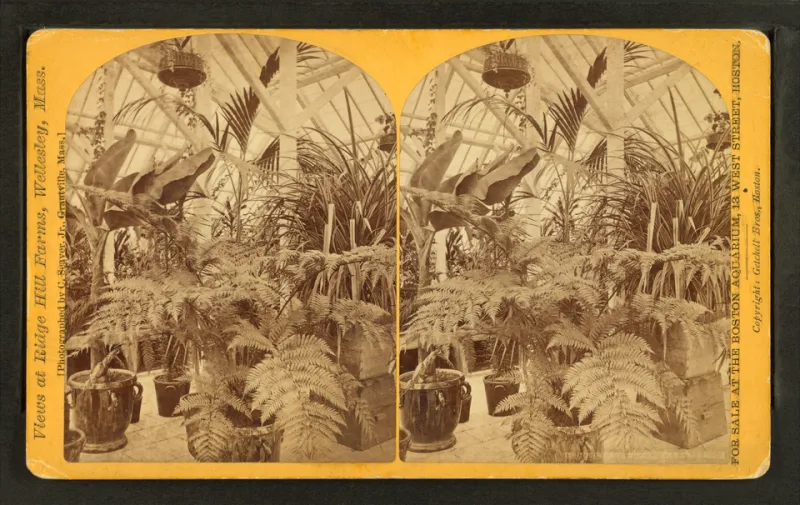
Photo: Getchell Bros. -- Copyright Holder, Public domain, via Wikimedia Commons
Conservatories are strange rooms. They're part of the house, but they behave like the outdoors. They're where you drink tea in February and where you can't sit at two in the afternoon in July. And because of all that glass, they're the room where wall colour gets tested harder than anywhere else in the building.
That's the thing about conservatories and garden rooms — you can't pick a colour for them the way you'd pick one for a bedroom. The usual rules bend. Here's what actually happens to paint under that much light, and how to choose around it.
Light that doesn't behave like light
In a normal room, daylight comes in from one or two directions and gets absorbed by walls. In a conservatory it comes in from everywhere, bounces off the floor, bounces off the glass, bounces off the furniture, and lands on your walls twice over. The effect is a room that reads considerably brighter than the paint on the tin.
Which means the colour you confidently matched in the hallway will look like a different paint in here. Sometimes a nicer one. Often a paler, flatter, more clinical version of itself.
There's a second issue: the light changes direction through the day far more dramatically than elsewhere. A south-facing conservatory at noon is basically an interrogation room. By six in the evening it's warm, low and golden. Colours that hold their nerve across that arc are usually the warm mid-tones — soft clay, stone, muted olive, oatmeal, a greyed terracotta. They don't go chalky at midday and they don't glow strangely at dusk.
The washed-out trap
This catches people out constantly. Pale greys, cool whites and the very fashionable soft blues tend to look crisp on the sample card and then dissolve into nothing once the sun hits them. You end up with walls that read as "untreated plaster" rather than "chosen colour".
If you want light walls in a conservatory — and most people do — go a shade or two deeper than you think, and lean warm rather than cool. A warm off-white with a bit of pigment in it will still feel airy but will hold its identity. A cool white will just look bleached.
At the other end, very saturated colours get a different treatment. In a room with this much bounce light, a deep green or rich blue will glow — sometimes beautifully, sometimes like a stained-glass window you didn't ask for. If you're going strong, test it thoroughly and consider keeping it to one wall.
The garden is in the room
You can't ignore that the view is part of the scheme. Whatever colour you put on the walls is going to be seen against foliage, lawn, fence, sky and whatever the neighbours have going on.
This is where greens get tricky. A sage or eucalyptus that looks elegant in a north-facing hall can turn faintly unwell next to a vivid summer lawn. Similarly, very yellow-based greens and the garden can end up competing rather than settling each other down.
A reliable approach is to pull the conservatory palette slightly away from the garden's dominant colour. Warm neutrals, stone, putty, muted reds and soft greys all sit comfortably beside greenery without trying to match it. If you do want green, choose one that's noticeably greyer or darker than the planting outside — that keeps it reading as a wall rather than an extension of the hedge.
Not every surface wants the same finish
Conservatories put finishes under real pressure, and it's worth splitting the room up.
Walls. A washable matt or a soft eggshell is usually the sensible middle ground — enough durability to cope with wiped-down spills and condensation marks, not so glossy that every pane of glass reflects in it. Full gloss on a big wall in a glass box is a lot.
Frames, sills and internal joinery. These take the brunt of condensation and temperature swings. A durable eggshell or satin here — the sort of thing you'd use on kitchen units — is a better bet than a standard emulsion.
South- and west-facing walls. These get the UV hammering. Cheaper pigments in strong colours fade noticeably, and reds and deep blues are the usual suspects. If a wall is in direct sun most of the day, either accept that it'll need refreshing sooner or nudge the colour a shade lighter, where fading is less obvious.
The ceiling. Often overlooked, often the largest painted surface in the room. A white ceiling in a conservatory can go grey and gloomy in winter because of condensation film. Something with a touch of warmth, in a finish you can wipe, holds up better.
Condensation is a paint problem and a ventilation problem
One honest note: paint can't solve condensation. It can only fail more or less gracefully. If your conservatory streams with water on cold mornings, sorting ventilation and heating first will save you repainting every couple of years. Once that's in hand, moisture-tolerant finishes will last considerably longer than standard emulsion, which tends to go soft, bloom and flake when it's permanently damp.
Test it the slow way
In a room like this, a painted patch the size of a postcard tells you almost nothing.
Paint an A3-sized sample — properly, two coats — on a piece of lining paper and tape it to the wall. Then look at it at 8am, at 2pm and at 7pm. Look at it on a grey day as well as a bright one, and if you can, look at it in January before committing. Conservatory colour chosen in June can be a genuine shock by December, because the room loses its borrowed garden light and the walls suddenly carry the whole scheme on their own.
Move the sample around too. The wall that faces the garden and the wall beside the house will not read the same.
The short version
Go warmer and slightly deeper than instinct suggests. Keep strong colour to one wall unless you've tested it thoroughly. Match the garden loosely, not literally. Split your finishes by surface rather than using one paint everywhere. And give yourself time to see a sample through a whole day.
Get that right and a conservatory stops being the room you repaint every three years and becomes the one that quietly earns its keep — all year, in all weathers.
If you'd rather have someone else squint at samples in the afternoon sun, that's the sort of thing we do most weeks.